A profitable tire recycling operation is not built around one shredder. It is built around a controlled material flow that converts irregular, steel-reinforced tires into a consistent saleable output. This tire recycling plant guide is designed for plant owners, project engineers, and procurement teams evaluating industrial equipment for whole tires, truck tires, OTR tires, and mixed scrap tire streams.
The right plant configuration depends on feedstock, target product, operating hours, contamination level, and local outlet markets. A line producing tire-derived fuel has different requirements from a plant producing clean rubber granules or fine rubber powder. Selecting equipment before defining the final product is one of the most expensive mistakes a buyer can make.
Start With the End Product and Feedstock
A tire recycling plant should be engineered backward from the material you intend to sell. Common outputs include rough tire chips for tire-derived fuel, wire-free rubber mulch, rubber granules for molded products and modified asphalt, and fine rubber powder for higher-value rubber applications. Each output has its own particle-size requirement, steel-removal standard, fiber-content tolerance, and production cost.
Feedstock matters just as much. Passenger tires are smaller and generally easier to process than truck tires. Agricultural and OTR tires can contain heavier bead wire, thicker sidewalls, and larger dimensions that may require pre-cutting or specialized infeed arrangements. A plant designed for clean passenger tires can lose capacity quickly when it receives a mixed stream of truck, off-road, and contaminated tires.
Before requesting a quotation, establish the average tire type, maximum tire diameter, expected monthly tonnage, desired operating shifts, and required final size. Also identify whether rims, dirt, moisture, or non-tire waste may enter the line. These details determine rotor design, cutter configuration, conveying capacity, magnetic separation strength, and screen selection.
Tire Recycling Plant Guide: Define the Processing Route
Most industrial tire recycling systems use staged size reduction rather than forcing whole tires through a single machine. The stages protect equipment, improve output consistency, and allow steel and fiber to be removed at the right point in the process.
Primary Shredding for Whole Tires
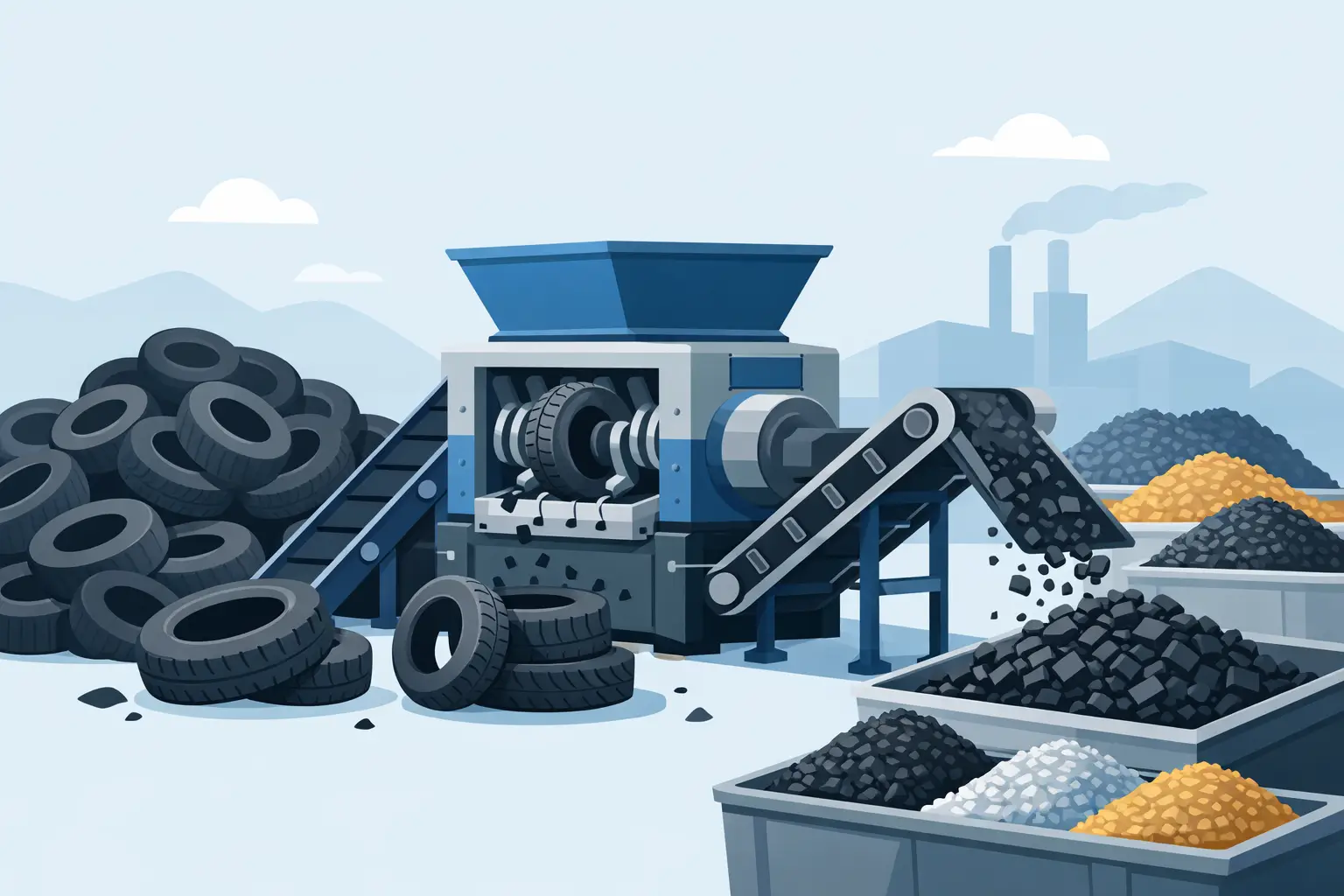
The first stage is typically a heavy-duty dual-shaft tire shredder. It tears whole tires into coarse strips or chips while handling the steel reinforcement that makes tire processing demanding. Low-speed, high-torque operation is preferred because it delivers controlled cutting force with lower noise and reduced dust compared with high-speed impact reduction.
Primary shredder output is commonly sized for downstream handling rather than final sale. The objective is to create pieces that move reliably through conveyors, magnets, screens, and secondary reduction equipment. Cutter material, shaft strength, gearbox capacity, and hydraulic drive protection deserve close attention here. A high nominal capacity is not useful if the shredder stalls on bead bundles or requires frequent cutter servicing.
Secondary Shredding and Granulation
After primary reduction, a secondary shredder or granulator reduces chips to a tighter size range. This stage has a direct effect on final material quality. A well-matched screen controls top size, while properly selected knives produce a more uniform chip shape and reduce unnecessary fines.
For granule production, the material may pass through additional granulation and classification stages. The plant should be designed so that oversized material returns automatically for reprocessing, while on-size material advances to separation. This recirculation loop is essential for stable production. Without it, operators often compensate by over-processing all material, increasing power consumption and wear.
Steel and Fiber Separation
Tires contain valuable steel and lightweight textile fiber, both of which must be managed intentionally. Overband magnets or drum magnets remove liberated steel after shredding and granulation. More than one magnetic stage is often justified when the plant must meet low steel-content specifications or when recovered steel is sold as a separate commodity.
Fiber separation generally follows finer size reduction. Air classifiers, zigzag separators, or aspiration systems pull textile fiber from rubber granules. The correct setup depends on particle size, fiber type, and the cleanliness required by the buyer. A tire-derived fuel line may accept more residual fiber than a line supplying rubber compound manufacturers.
Screening and Final Classification
Screening is where a plant turns variable shredded material into a defined commercial product. Trommel screens are effective for durable, free-flowing chip streams, while flip-flow screens can perform well with difficult, elastic, or moisture-affected material that tends to blind conventional screening media. The screen should be selected for the actual material behavior, not only the specified aperture.
For plants producing multiple grades, screening can divide output into several fractions without disrupting the core process. That flexibility is valuable when market demand changes. However, more product grades also mean more storage, handling, quality checks, and inventory control.
Build Capacity Around the Real Bottleneck
Nameplate throughput is only a starting point. Actual plant capacity is limited by the slowest stable point in the line, which may be the primary shredder, secondary grinder, screen, steel separator, or discharge system. Capacity also changes with tire mix, cutter condition, ambient temperature, moisture, and operator practices.
A practical design includes surge capacity between critical machines. Feed conveyors and buffer hoppers allow one stage to continue operating during short interruptions downstream. This reduces stop-start cycles, which are hard on motors, gearboxes, and cutting chambers. At the same time, excessive buffering can hide poor equipment matching, so it should support the process rather than compensate for an undersized machine.
When comparing proposals, ask suppliers to specify capacity by feedstock and final size. “10 tons per hour” has limited value unless it states whether that figure applies to passenger tires, truck tires, mixed tires, coarse chips, or clean granules. Request an equipment layout and mass-flow description that shows how material moves from infeed to finished-product storage.
Specify the Support Systems Early
The core machinery receives the most attention, but plant reliability often depends on systems around it. A complete line should consider infeed conveyors, discharge conveyors, belt scales, magnetic separators, dust collection, electrical controls, fire prevention, and finished-product storage.
Dust control becomes increasingly important as rubber is reduced into smaller particles. Enclosed transfer points, local extraction hoods, and correctly sized filtration help maintain safer working conditions and reduce housekeeping labor. The dust system must be integrated with the processing line. Adding it after installation can create poor pickup points and obstruct maintenance access.
Fire planning should be part of the original engineering scope. Rubber stockpiles, fine rubber particles, and friction-generated heat require disciplined housekeeping, temperature monitoring where appropriate, emergency access, and site-specific suppression measures. Requirements vary by jurisdiction and insurer, so the plant layout should leave room for compliant fire lanes, electrical cabinets, and safe material storage.
Automation should focus on useful control rather than complexity for its own sake. A centralized PLC system can coordinate conveyors, prevent material overload, monitor motor current, and trigger safe shutdown sequences. Remote diagnostics and production data can help maintenance teams identify recurring bottlenecks before they become costly failures.
Evaluate Equipment for Serviceability, Not Just Purchase Price
Tire recycling is a wear-intensive application. Knives, screens, bearings, hydraulic components, and conveyors all require planned inspection and replacement. A lower initial machine price can become costly if cutter changes take too long, wear parts are difficult to source, or access to the cutting chamber is poor.
Ask direct questions about knife material, reconditioning cycles, expected wear life under your feedstock, bearing protection, gearbox brand, and spare-parts lead time. Confirm that the design permits safe access for cleaning and maintenance. In a continuous operation, hours lost to an awkward service procedure can cost more than a higher-quality original component.
For export projects, documentation and commissioning support are equally important. Electrical standards, voltage, control-language requirements, shipping dimensions, installation drawings, and spare-parts packages should be confirmed before production begins. Zhengzhou Jinpeng Machinery Equipment Co., Ltd. can configure integrated shredding, screening, separation, and conveying systems around these project-specific requirements rather than treating each machine as an isolated purchase.
Plan the Site and Operating Model
A tire recycling line needs more than floor space. Consider tire receiving and inspection, quarantine space for unsuitable feedstock, forklift routes, finished-product bays, steel collection, maintenance clearance, and truck loading. Poor traffic design creates avoidable labor and safety problems even when the equipment itself performs well.
Labor requirements depend on automation level and material quality. A cleaner, more consistent tire supply lowers sorting demands and improves uptime. Mixed incoming waste may justify a dedicated inspection and removal station before shredding, particularly where rims, large metal pieces, or non-tire debris are common.
The strongest investment case combines realistic throughput with a clear market for every output stream. Rubber, steel, fiber, and oversize rejects all need a destination. Build the plant around a product specification your buyers will accept, then select machinery capable of producing that specification consistently shift after shift.