A biomass line fails long before the boiler, pellet mill, or gasifier stops. It fails when oversized wood, wet fines, soil, metal, and inconsistent feedstock enter the process without control. This industrial biomass preparation guide outlines how industrial plants convert variable wood and green waste into uniform, reliable fuel feedstock while protecting downstream equipment and production targets.
For plant owners and project engineers, preparation is not a single machine purchase. It is a system decision involving feedstock conditions, required particle size, moisture targets, hourly capacity, contaminant removal, and material flow. The right configuration reduces manual handling, stabilizes output, and turns difficult residues into a marketable fuel product.
Start With the Feedstock, Not the Machine
Industrial biomass can include forestry residues, whole logs, sawmill offcuts, bark, branches, pallets, demolition wood, orchard prunings, and green waste. These materials may all be called wood waste, but they do not behave the same way in a processing line.
Fresh branches and green chips often carry high moisture and soil contamination. Sawmill residues are generally cleaner but can vary between bark, slabs, shavings, and long trim pieces. Recovered pallets and demolition wood require stricter contaminant control because nails, screws, plastics, and painted materials can damage equipment or limit the fuel’s end use.
Before selecting equipment, define the feedstock by its maximum dimensions, bulk density, moisture range, contamination level, and daily volume. A line designed for clean mill residues should not be expected to process root balls, mixed green waste, or nail-bearing pallets at the same capacity. The operating assumptions must reflect the worst expected material, not only the ideal material delivered during trials.
Set the Finished Material Specification
The final application determines the preparation standard. A biomass boiler may accept screened chips within a broad size range, while a pellet plant needs much finer, more uniform material. Gasification systems can be especially sensitive to chip geometry, fines content, and moisture variation. RDF and SRF production may require biomass to be sized around other combustible fractions rather than prepared as a standalone wood fuel.
A practical specification should define particle size, allowable oversize, fines percentage, moisture range, contaminant tolerance, and required throughput. For example, a boiler fuel project may target consistently screened wood chips with controlled fines and moisture suitable for stable combustion. A pellet feed line will usually add fine grinding after drying to achieve the particle distribution required by the pelletizing process.
Avoid specifying a smaller particle size than the downstream process truly needs. Fine grinding consumes more power, increases wear, and can create excessive dust. Coarse, uniform chips are often the most economical output for direct combustion, while fine material is justified only where pelletizing, briquetting, or specialized thermal conversion requires it.
Build the Industrial Biomass Preparation Guide Around Process Stages
A dependable preparation line typically follows the material’s physical condition. Bulky material must first be received and metered. It is then reduced, cleaned, sized, screened, and, where required, dried and refined. Conveyor design and storage buffers connect these stages and prevent one machine from starving or overloading another.
Receiving, feeding, and metering
The receiving area must handle irregular deliveries without forcing operators to manually sort or push material into the equipment. Heavy-duty infeed conveyors, live-floor systems, chain conveyors, and hydraulic feeders can regulate flow from stockpiles or loading equipment.
Metering is critical because chippers, shredders, grinders, and dryers perform best with controlled loading. A machine rated for high capacity can still produce poor output if it receives sudden surges followed by empty periods. Variable-frequency drives, level sensors, and interlocked controls help maintain a steady material bed through the line.
Primary size reduction
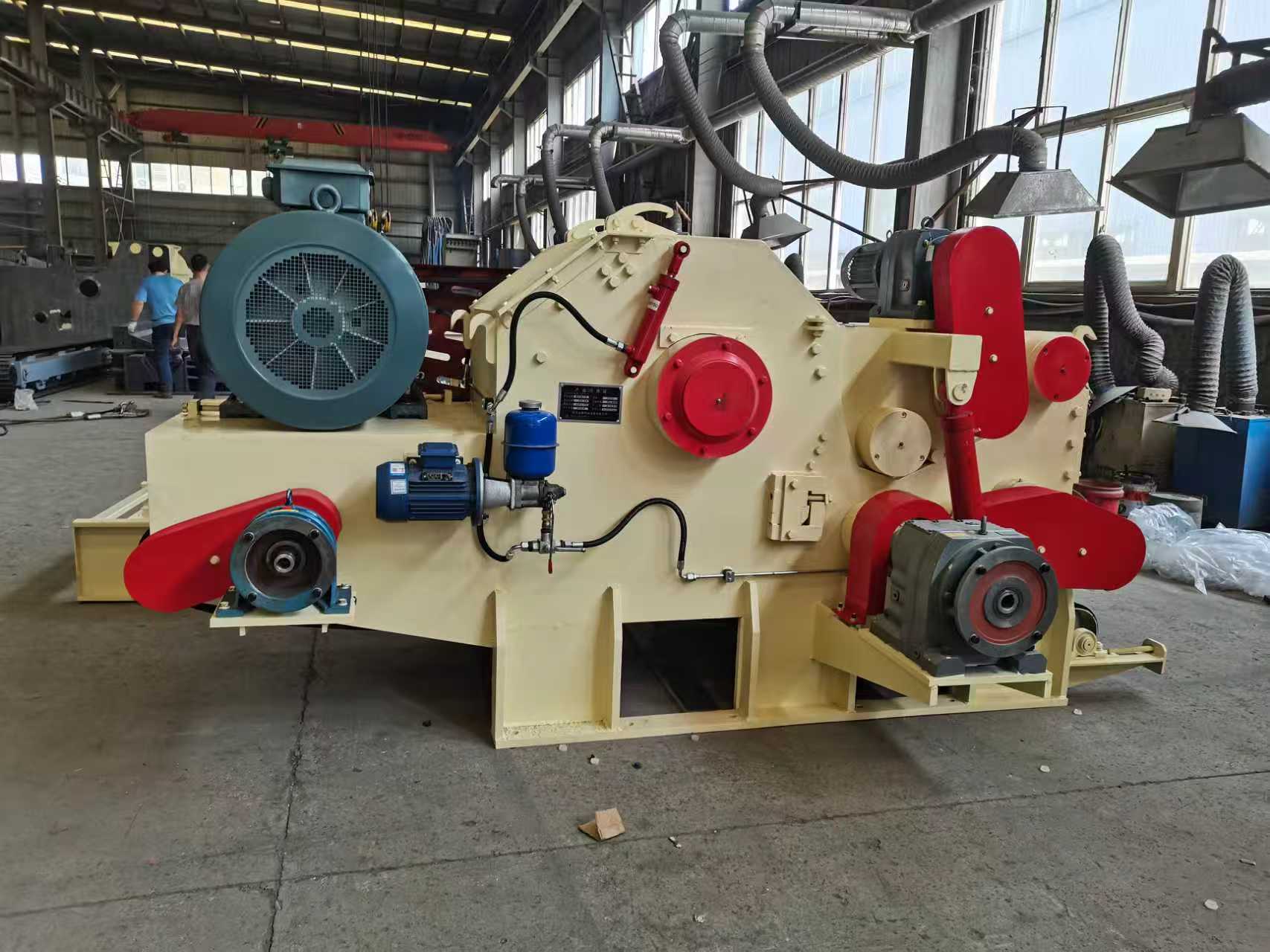
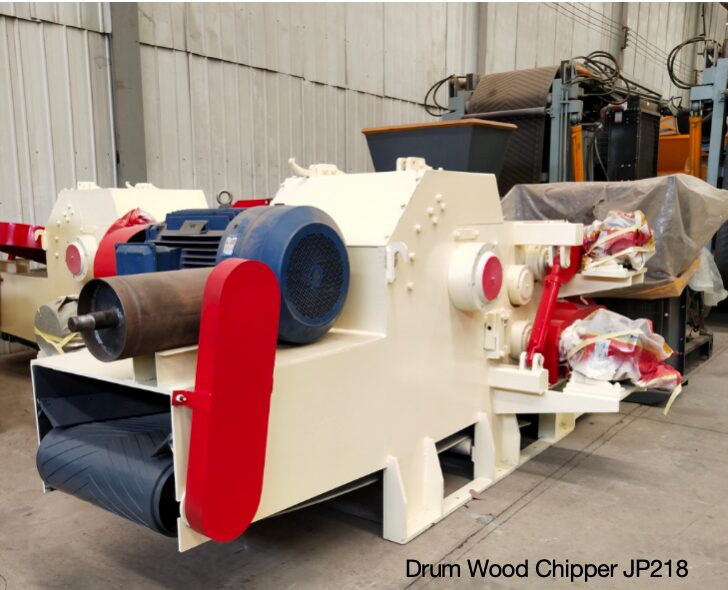
The primary machine depends on feedstock shape and contamination. Disc wood chippers and drum chippers are effective for logs, branches, slabs, and clean woody material when a chip product is required. A debarker may be installed ahead of chipping when bark content affects fuel quality or wood-chip value.
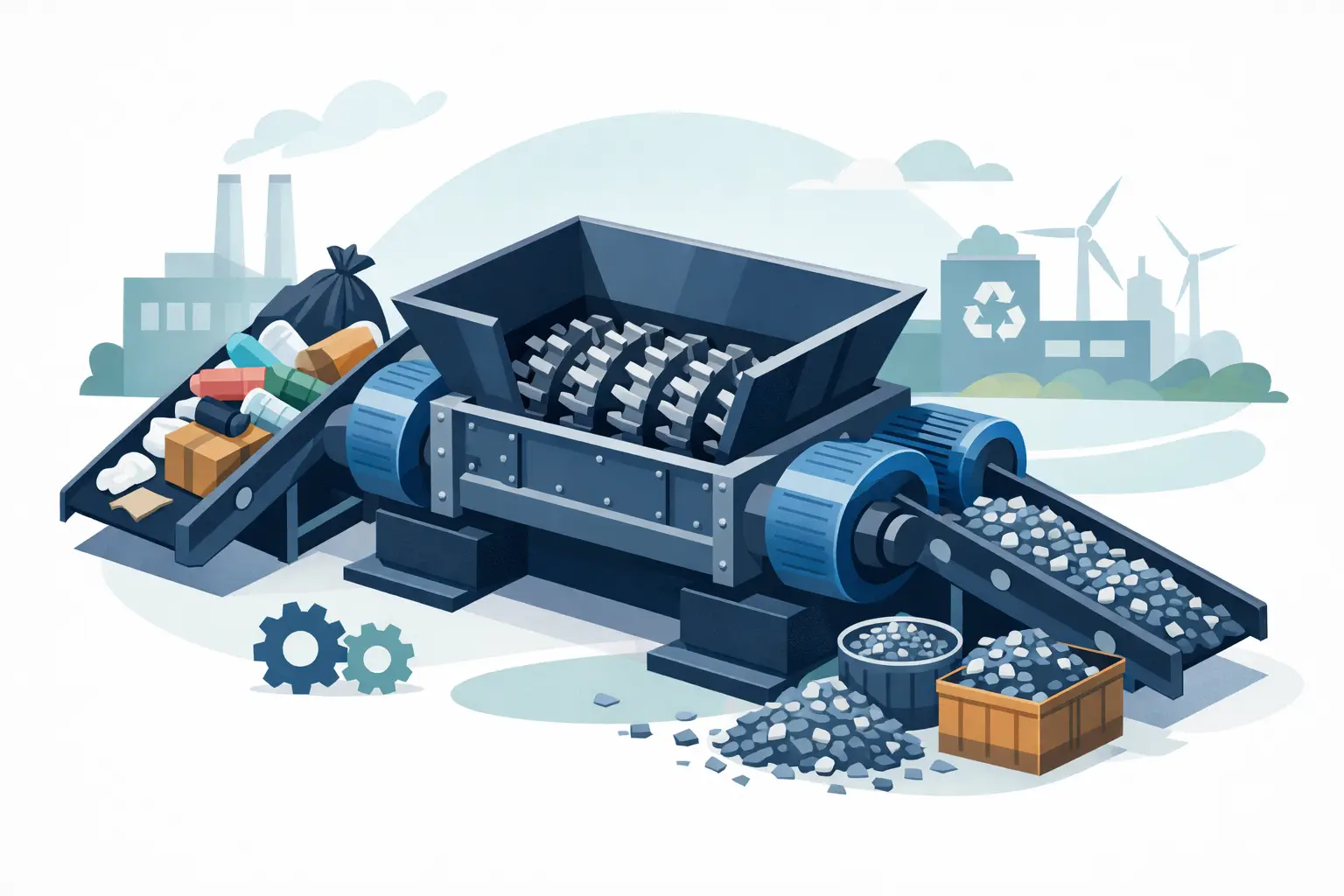
For mixed green waste, pallets, bulky offcuts, and difficult industrial wood residues, a horizontal grinder or heavy-duty shredder may be more appropriate. Single-shaft shredders provide controlled reduction for many wood and waste streams. Dual-shaft shredders are often selected for bulky, tangled, or tougher feedstock that needs aggressive initial tearing before further processing.
The trade-off is straightforward: chipping can deliver a more defined chip shape from suitable wood, while shredding and grinding provide greater tolerance for irregular material. The correct choice depends on the feedstock and the required output, not on machine category alone.
Screening and contamination removal
Screening separates usable material from oversize pieces and fines that can destabilize the final product. Trommel screens are commonly used for wood chips, compost-like green waste, and materials with variable particle size. Flip-flow screening machines are valuable where wet, sticky, or difficult fines would blind conventional screen decks.
Oversize material can be returned to the grinder or chipper for reprocessing. This closed-loop arrangement improves size consistency without forcing all material through an overly restrictive first-pass screen.
Magnetic separation should be considered whenever nails, wire, or ferrous debris may be present. Depending on the source material, additional separation methods may be needed for stones, plastics, or nonferrous metals. Removing contaminants early protects cutters, screens, conveyors, dryers, and downstream combustion equipment from avoidable damage.
Drying and fine grinding
Moisture is one of the most consequential variables in biomass fuel preparation. Wet material reduces heating value per ton, increases transport cost, affects storage behavior, and may prevent stable pelletizing or combustion. Yet drying is also energy-intensive, so it should be applied only to the degree required by the end use.
Rotary dryers are widely used for continuous, high-volume reduction of wood chip, sawdust, and biomass moisture. Their design must match the inlet moisture, desired final moisture, particle size, heat source, and residence time. A dryer cannot compensate for uncontrolled feed size. Large chunks, excessive fines, and uneven material flow will reduce thermal efficiency and make moisture control more difficult.
After drying, fine wood grinder mills can reduce material to the required size for pellet mills, briquette presses, or other densification equipment. Grinding after drying is common because dry material can be easier to mill consistently, although the exact sequence depends on the feedstock and overall process design.
Design for Capacity, Wear, and Uptime
Nameplate capacity is not the same as sustained plant output. A 20-ton-per-hour preparation line must be evaluated across receiving, primary reduction, screening, drying, recirculation, and discharge. The lowest reliable capacity among these stages sets the actual production rate.
Use a realistic operating schedule that accounts for maintenance, screen cleaning, cutter changes, truck unloading, and feedstock variability. Plants processing abrasive, dirty, or recycled wood should expect higher wear on knives, hammers, screens, and conveyor components than plants handling clean sawmill residues. Access for maintenance is not a minor detail. It determines whether a planned service task takes one hour or consumes an entire shift.
Dust collection, fire prevention, emergency stops, bearing temperature monitoring, and overload protection must be integrated into the design. Dry biomass and fine wood dust require disciplined housekeeping and properly engineered safety measures. Capacity without safe, stable operation is not useful capacity.
Choose a System Partner That Can Engineer the Interfaces
A line built from disconnected machines often creates bottlenecks at transfer points, mismatched conveyor speeds, poor control logic, and difficult commissioning. For larger projects, buyers should evaluate suppliers on their ability to size the complete process, not only sell individual equipment.
Zhengzhou Jinpeng Machinery Equipment Co., Ltd. supplies integrated solutions covering chipping, shredding, grinding, screening, drying, and conveying for industrial biomass and waste processing. A properly engineered line can be configured around local feedstock, target fuel specification, site layout, utilities, and export delivery requirements.
The most profitable biomass projects are usually not the ones with the most machines. They are the ones where every stage is matched to the material, where output quality is measurable, and where maintenance can be planned before downtime becomes a production loss. Start with representative feedstock samples and a clear finished-fuel specification, then build the line around the conditions your plant will actually face.