Green waste does not fail slowly. It shows up all at once – storm debris after a weather event, municipal brush from seasonal cleanup, pallets mixed into yard trimmings, and wet organics that clog lighter-duty machines. A horizontal grinder for green waste has to process that variability without turning your yard into a bottleneck or your maintenance budget into a second operating crisis.
For plant owners, recycling operators, biomass fuel producers, and municipal contractors, the buying decision is rarely about one specification. It is about whether the machine can hold production through changing feedstock, inconsistent moisture, and long operating hours. If the grinder cannot maintain throughput or produce a usable discharge size, the rest of the line suffers.
What a horizontal grinder for green waste needs to handle
Green waste is not a uniform material stream. One load may contain branches, leaves, hedge trimmings, roots, and small logs. The next may include oversized wood, stumps with dirt contamination, or mixed C&D wood from transfer stations. That variation is exactly why horizontal grinders are widely used in this application. Their feed system, open infeed design, and aggressive grinding action are better suited to bulky, irregular, and longer material than many smaller reduction machines.
In practical terms, a horizontal grinder for green waste should be evaluated on how well it handles three realities: changing particle size at the infeed, fluctuating moisture, and contamination risk. Wet green material behaves differently from dry woody biomass. It can bridge, compact, and reduce cutting efficiency. Contaminants such as stones, metal, and soil accelerate wear. A grinder built for this duty must be engineered for impact resistance, stable feeding, and predictable maintenance intervals.
Throughput is not just a nameplate number
Many buyers start with hourly capacity, and that is reasonable. But quoted throughput can be misleading if it does not match actual feedstock conditions. A machine rated for high output on clean wood may perform very differently on mixed municipal green waste with high moisture and fines.
The more useful question is how the grinder performs across your real operating window. If your site processes 20 tons per hour on average but spikes to 40 during peak collection periods, the machine needs enough reserve power and feed control to absorb those peaks. Otherwise, operators slow the line, rehandle material, or let inventory build up in the yard.
That is where system design matters. Conveyor width, feed roller pressure, rotor power, screen selection, and discharge handling all influence true production. A properly specified machine will not just hit a lab number. It will keep material moving through an actual plant environment.
Feed system design affects production stability
An underbuilt feed system creates problems long before the rotor becomes the issue. Uneven feeding reduces efficiency, increases wear, and leads to inconsistent final size. For green waste applications, hydraulic feed rollers and heavy-duty chain or steel slat conveyors are often preferred because they control bulky material more effectively and reduce the chance of surging.
If your feedstock includes brushy or stringy material, infeed geometry becomes especially important. Material needs to be pulled into the grinding chamber without repeated operator intervention. That directly affects labor requirements and machine utilization.
Rotor, hammer, and screen choices define output quality
The same green waste stream can end up as compost feedstock, mulch, boiler fuel, or RDF blend material depending on how it is processed. Output requirements should drive machine configuration from the start.
Rotor speed and hammer design influence both reduction efficiency and wear life. A more aggressive setup may improve size reduction but can increase fines or wear under abrasive conditions. A less aggressive setup may protect components but leave oversize material that requires recirculation. There is no universal best option. It depends on your target product and contamination level.
Screens matter just as much. Finer sizing for biomass fuel preparation typically requires more energy and may reduce throughput on wet feedstock. Coarser mulch or compost pre-grind applications can often run faster and with lower operating cost. Buyers should be clear about whether the machine is intended for primary grinding, final product sizing, or a staged reduction line.
When finer output is the wrong goal
Some operations over-specify fine output because it sounds more marketable. In reality, grinding green waste too fine at the first stage can create handling problems, especially when moisture is high. Wet fines can pack conveyors, reduce airflow in storage piles, and complicate screening. In many facilities, a controlled medium output followed by downstream screening or secondary processing is the more efficient solution.
Wear resistance and maintenance access are where cost is won or lost
A grinder that looks competitive on purchase price can become expensive if wear parts are short-lived or difficult to change. Green waste often carries hidden abrasion from sand, stones, and soil. Root balls and land-clearing debris are particularly hard on hammers, liners, and screens.
That is why serious buyers look beyond horsepower. Maintenance access, wear part design, and component protection have a direct effect on lifetime operating cost. Easy access to the rotor area, logical placement of service points, and durable hammer and screen systems reduce downtime during routine service.
For export buyers and industrial projects, parts availability is equally important. A machine should be supported not only with the core unit but with recommended wear packages, commissioning guidance, and technical documentation that fits the production plan. In high-volume operations, one delayed part can cost more than the original price difference between machines.
Mobility versus stationary installation
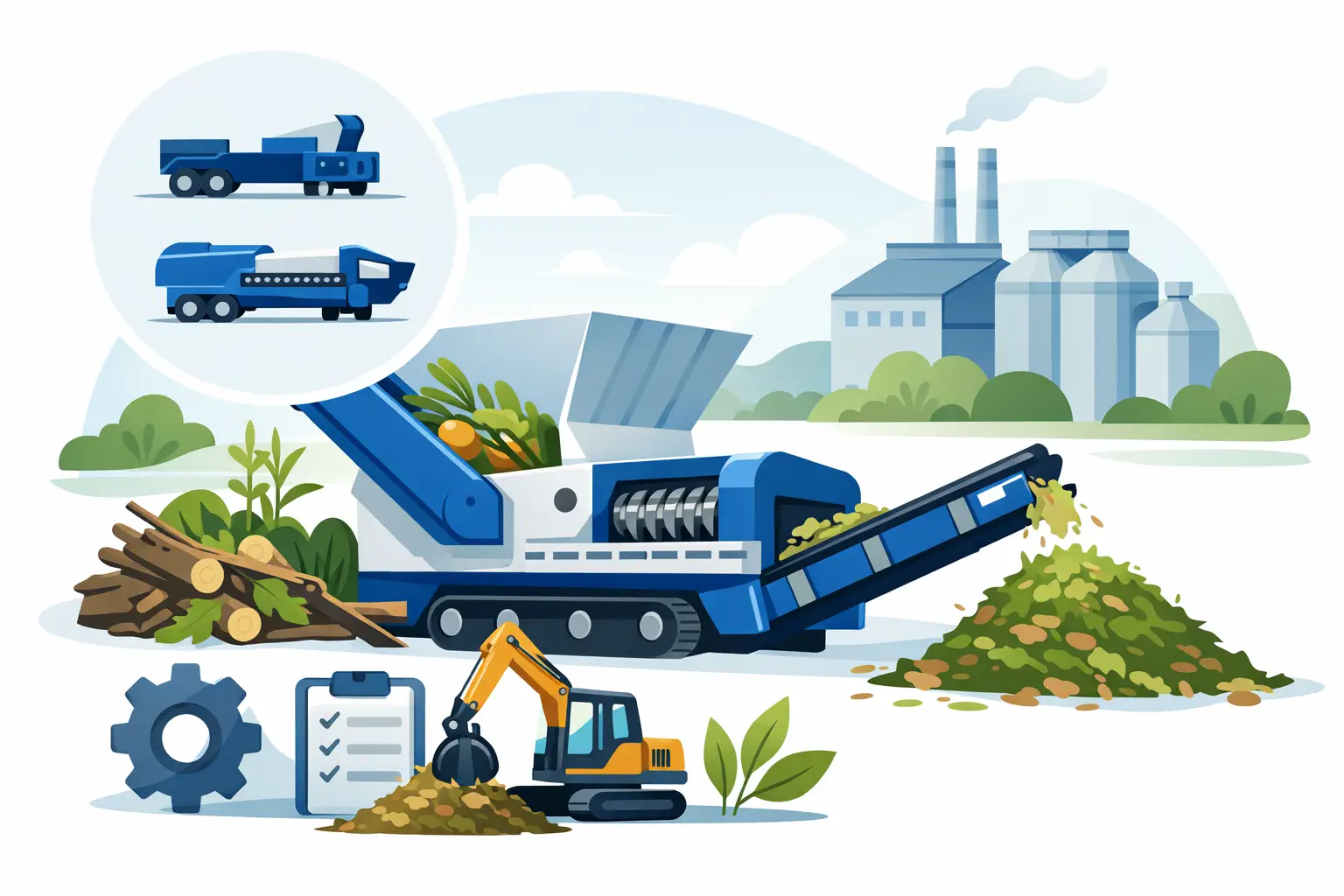
Not every horizontal grinder for green waste belongs in the same operating model. Some buyers need mobile equipment for site cleanup, municipal collection points, or contract grinding. Others need a stationary unit integrated into a larger recycling or biomass line.
A mobile grinder offers flexibility and can reduce haulage of bulky raw material. That is useful for contractors or operations working across multiple sites. The trade-off is that mobility may limit certain aspects of line integration, discharge configuration, or plant-wide automation.
A stationary grinder is usually the better fit for continuous industrial production. It can be connected with pre-sorting, magnetic separation, screening, storage, and downstream drying or fuel preparation equipment. For large green recycling facilities, the higher value often comes from system efficiency rather than machine mobility.
Integration matters more than most buyers expect
A grinder rarely works alone for long. Once throughput increases, upstream and downstream equipment become the real constraints. If green waste arrives unsorted, a shredder, screen, or manual picking station may be needed before grinding. If the output is sold as biomass fuel or compost feedstock, discharge conveyors, magnetic separators, trommel screens, or stockpiling systems may be necessary after the grinder.
This is where a broader equipment portfolio becomes useful. A manufacturer that understands shredding, screening, and drying can help configure a line around the grinder instead of treating the grinder as an isolated purchase. For buyers planning a new facility or expansion, that approach reduces integration risk and helps match each machine to the actual process target.
Zhengzhou Jinpeng Machinery Equipment Co., Ltd. serves this kind of industrial requirement by supplying horizontal grinders alongside shredders, screens, and biomass preparation equipment for complete processing solutions.
What to ask before requesting a quote
A productive quote process starts with application data, not just budget. Buyers should define the feedstock mix, expected moisture range, contamination level, target hourly capacity, desired output size, operating hours, and whether the machine will be mobile or stationary. It also helps to state whether the goal is mulch, compost feedstock, biomass fuel, or volume reduction.
Suppliers can then recommend rotor configuration, power range, screen options, discharge setup, and line integration. That conversation is far more valuable than comparing bare machine prices. A lower-cost machine that misses output requirements or suffers frequent wear will not stay lower-cost for long.
There is also value in discussing future expansion. If your current volume is moderate but municipal contracts or biomass demand are expected to grow, it may make sense to choose a platform that can be integrated into a larger line later. Capacity planning should reflect where the business is going, not only where it is today.
The right machine is the one that matches your material reality
A horizontal grinder for green waste should not be selected as a generic wood-processing machine. Green waste is wetter, more variable, and often more contaminated than clean wood feedstock. That changes the equation on feeding, wear, output control, and maintenance strategy.
Buyers who get the best results usually define the application in operational terms: what comes in, what must come out, and what level of uptime the plant needs to remain profitable. Once those conditions are clear, the machine specification becomes much more precise. That is when a grinder stops being a catalog item and starts becoming part of a production solution.
If you are planning a green waste recycling line, think beyond nominal capacity and ask how the equipment will perform on your worst day, not just your best material. That is usually where the right investment becomes obvious.